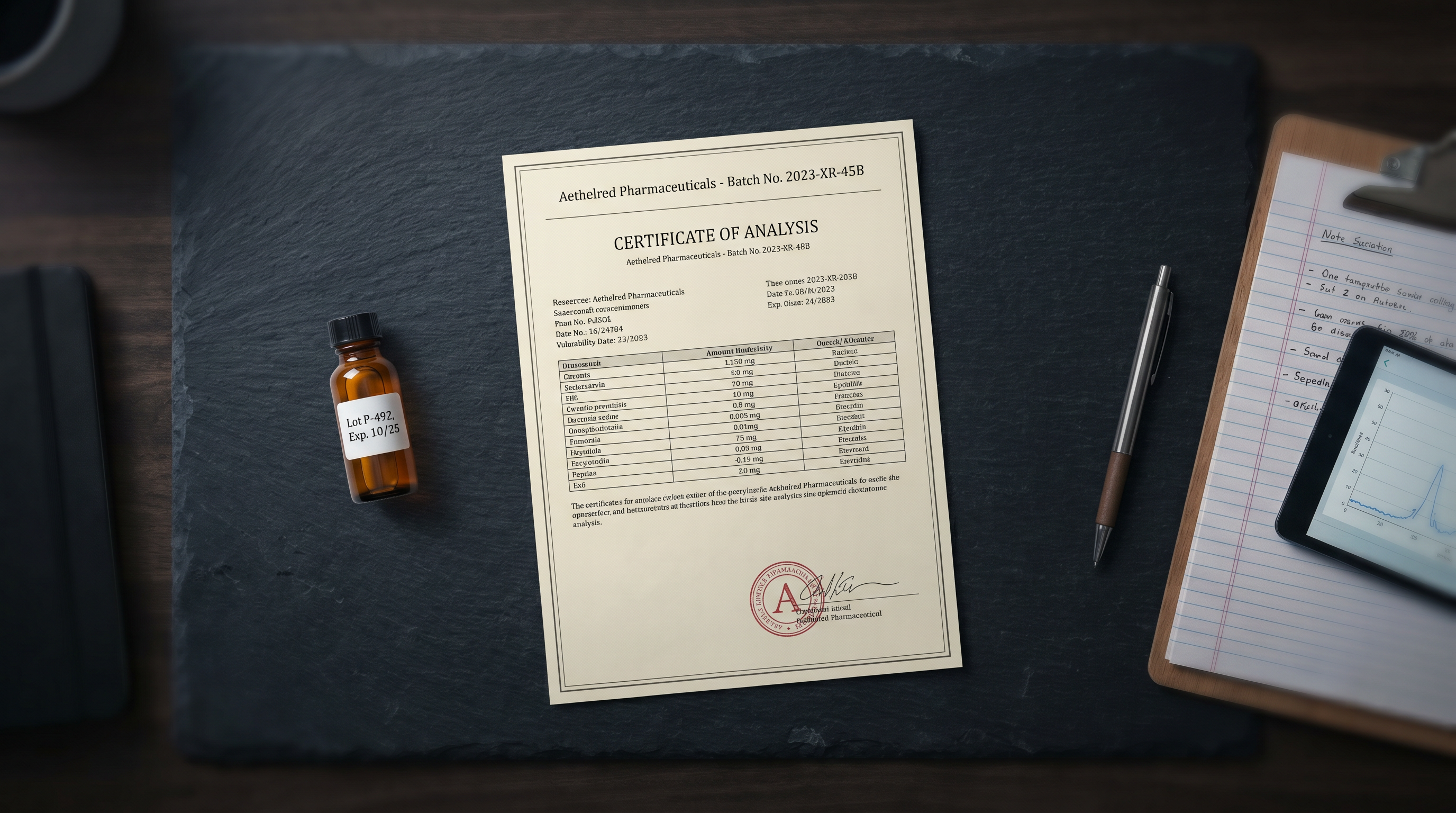
What a Certificate of Analysis Actually Tells You
Article Summary
A Certificate of Analysis (COA) is a document issued by a laboratory confirming the results of analytical testing on a s…
A credible COA from an independent laboratory will include the product name and batch number, the test methods applied, …
The most important test for peptide identity and purity is High-Performance Liquid Chromatography (HPLC).
A COA is only as useful as the testing behind it. We explain what independent third-party analysis covers, what it does not, and how to read a COA from a professional supplier.
A Certificate of Analysis (COA) is a document issued by a laboratory confirming the results of analytical testing on a specific batch of product. For professional buyers of research peptides, the COA is the primary quality document — but its value depends entirely on who conducted the testing and what methods were used.
What a COA Should Contain
A credible COA from an independent laboratory will include the product name and batch number, the test methods applied, the results obtained, the acceptance criteria against which results are judged, and the laboratory's identity and accreditation details. Without all of these elements, the document is incomplete.
The most important test for peptide identity and purity is High-Performance Liquid Chromatography (HPLC). This method separates the components of a sample and measures their relative abundance, giving a purity percentage. A result of 98% or above is generally considered acceptable for research-grade material, though specification limits vary by compound.
The Importance of Independence
A COA issued by the manufacturer's own internal laboratory carries less weight than one issued by an accredited third-party facility. Internal testing is not inherently unreliable, but it lacks the independence that external accreditation provides. When evaluating a supplier, always ask whether the COA comes from an independent laboratory with no commercial relationship to the production facility.
UK Peptide Manufacturing & Supply
Thanet Labs is a UK-based peptide manufacturing and supply facility working towards MHRA manufacturing authorisation. We are establishing supply relationships with research institutions, universities, and pharmaceutical development partners. Enquiries are welcome at this stage.
Register InterestMass Spectrometry and Molecular Verification
HPLC confirms purity but does not confirm molecular identity. Mass spectrometry (MS) is the standard method for verifying that a compound is what it claims to be. MS measures the molecular weight of the compound and compares it against the known theoretical mass. A credible COA for a peptide should include both HPLC purity data and MS identity confirmation.
What a COA Does Not Tell You
A COA confirms the quality of a specific batch at the time of testing. It does not guarantee stability over time, confirm appropriate storage conditions have been maintained, or verify that the product has been handled correctly since leaving the laboratory. For lyophilised peptides, reconstitution conditions and storage temperature are critical factors that fall outside the scope of the COA.
Professional buyers should treat the COA as a necessary starting point, not a complete quality assurance picture. Supplier transparency, documented manufacturing procedures, and consistent batch-to-batch performance are equally important considerations.
References
- 1.International Council for Harmonisation (ICH). Q6A: Specifications: Test Procedures and Acceptance Criteria for New Drug Substances and New Drug Products. 1999.
- 2.United States Pharmacopeia. General Chapter <621> Chromatography. USP-NF.
- 3.European Medicines Agency. Guideline on the Development and Manufacture of Lyo-Preparations. EMA/CHMP/QWP/198/01.